



Most stationery gifts fail for the same reason: they were assembled in a checkout queue. A notebook here, a novelty pen there, a card because a card is expected. Each piece is fine on its own, and together they look like exactly what they are — three unrelated purchases dropped into a paper bag.
A set that lands does the opposite. It feels chosen. Every item answers the same small question: who is this for, and what do they actually do with paper? The good news is that coherence costs less than volume. Thirty dollars is enough to build something that looks intentional, as long as you spend it in the right order and resist the urge to fill empty space. Here is how to do it from scratch, even if you have never put a gift set together before.
Start With a Theme, Not a Shopping List
Before you look at a single product, decide what kind of paper person you are buying for. Not their personality — their habits. Do they keep a work notebook that travels between meetings? Do they write actual letters to an aunt overseas? Do they sketch on the train, or plan their week in small squares?
A theme narrows everything that follows: the size, the ruling, the colours, even the wrapping. A few that work well:
- The quiet desk. One A5 notebook, a fine-liner, a slim bookmark. Neutral covers, one accent colour.
- The correspondent. Letter paper or a pad, a rollerball, postcards, a sheet of nice stamps if you know what they collect.
- The bag carrier. A pocket-sized notebook, a sturdy pen with a clip, sticky notes that survive being sat on.
- The list maker. A checkbox or to-do notebook, two pens in different colours, a small pad for groceries and errands.
Pick one, then commit to a palette of two colours plus a neutral: navy and rust on cream, sage and charcoal on white. This single decision does more for the finished set than any individual item. It also stops you buying the cheerful patterned notebook that clashes with everything else in the bag.
The Notebook Is the Anchor
Spend the largest share of your budget here. A notebook is the piece the recipient will handle every day, and the difference between a flimsy one and a well-made one is obvious within a week.
What to check before you commit
Size. A5 (roughly 14.8 by 21 cm) is the safe default — big enough to write in comfortably, small enough to carry. Pocket sizes are charming but often go unused because they are too cramped for real notes.
Binding. Thread-sewn or stitched notebooks lie flat, which matters more than people expect. Spiral is practical for a desk but awkward in a bag. Glued spines are fine for a slim notebook and frustrating for a thick one.
Paper. For everyday writing, 80 to 100 gsm is standard; heavier paper handles fountain pens and markers without bleed. If you can, open a copy and run a thumb across a page. Thin, scratchy paper is the fastest way to make a set feel cheap.
Ruling. Lined for writing and letters, dot grid for bullet journals and diagrams, blank for sketching, grid for anything mathematical. Getting this wrong is the most common reason a gifted notebook stays empty.
One good notebook beats three thin ones. Resist the multipack.
Two Writing Tools, Not Five
A set with six pens looks like a supermarket back-to-school offer. A set with two looks considered. Choose one main writer and one accent.
For the main pen, a decent gel or rollerball in black or dark blue is hard to beat: smooth, familiar, and pleasant to hold. Look for a metal clip, a cap that posts firmly, and a body that does not feel hollow. If the recipient writes letters, a fine-liner with archival ink is a safer gift than a fountain pen — fountain pens are deeply personal, and a cheap one is more likely to frustrate than delight.
The accent can be a second pen in a colour that matches your palette, a mechanical pencil with a soft eraser, or a couple of good wooden pencils and a sharpener. Two pencils and an eraser count as one accent; that is allowed.
Then test both. Scribble a few lines on scrap paper before wrapping. A pen that skips or scratches will undo the goodwill earned by everything else in the box, and it is the one flaw a recipient will notice immediately.
Small Paper Goods Give the Set Its Personality
This is where a gift set starts to feel like it was made for one person rather than bought for a category. Aim for two or three small items, and vary their shape: something flat, something useful, something to keep.
- Flat: postcards, a sheet of stickers, washi tape, a folded letter pad.
- Useful: sticky notes, index tabs, a small pad of list paper, quality paper clips.
- Keepable: a brass bookmark, a pressed botanical card, a screen-printed postcard they might frame.
Washi tape is inexpensive and adds colour fast, but only if the recipient actually crafts or journals — otherwise it becomes drawer clutter. The same goes for novelty erasers shaped like fruit. If an item exists only to fill space, leave it out; a slightly emptier set always looks better than a padded one.
The card is not a formality. It is the cheapest item in the set and the one most likely to be kept. Write two specific lines instead of "enjoy" — mention the notebook's ruling and why you picked it, or the pen and the letters you hope to receive.
A Budget Split That Holds Together
Prices shift by shop, season and country, so work in proportions rather than exact figures. If you are aiming to stay comfortably under $30, this rough split keeps the set balanced:
- Roughly half on the notebook — the anchor deserves the most.
- About a quarter on pens or pencils — two good writers, or one very good one.
- About a fifth on small paper goods — two or three items, no more.
- The remainder on wrapping — kraft paper, twine, a card, a paper band.
Check the total before you reach the till, not after. If you overshoot, the notebook stays and the small goods go. Never downgrade the anchor to keep the extras.
Presentation Does Half the Work
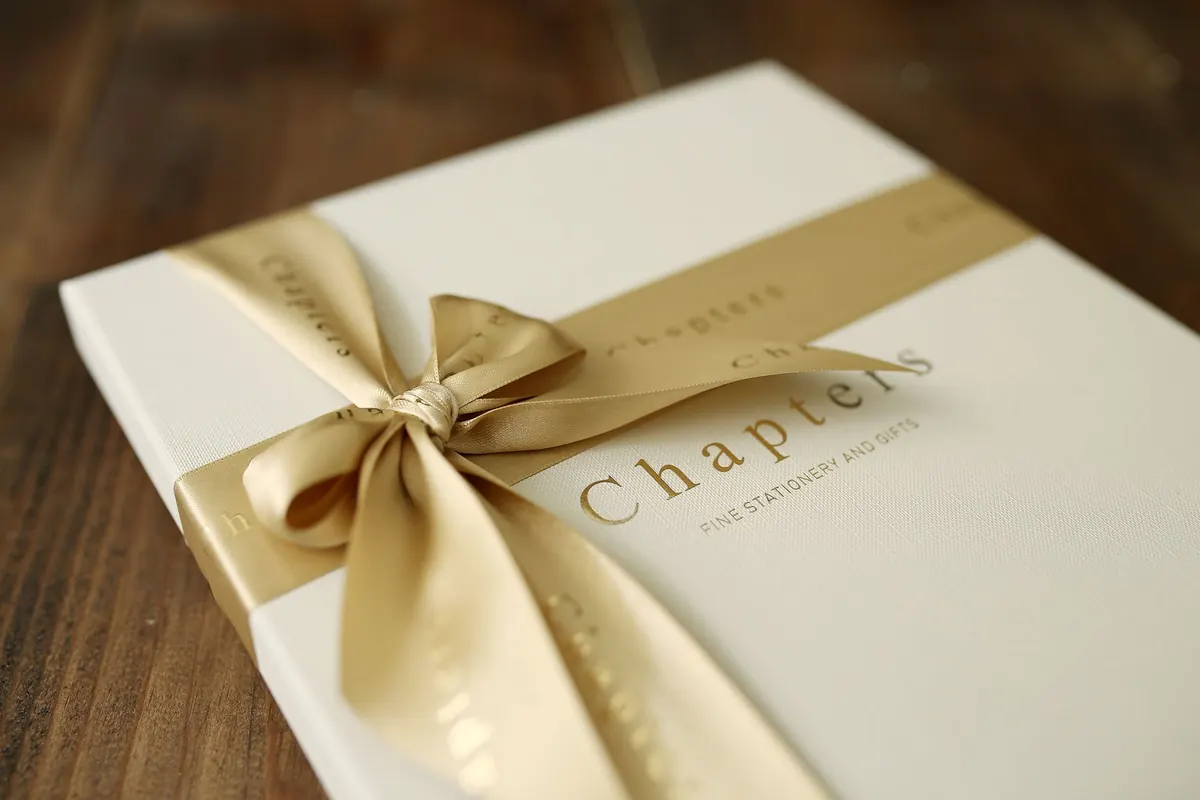
A bundle wrapped in brown paper and tied with twine reads as more thoughtful than the same items loose in a glossy bag. You do not need a gift box. In fact, a box often forces you to buy filler to stop things rattling around.
Lay the items in a slight fan, largest at the back, and tie them with a ribbon or cotton twine so they hold together. Add a paper band around the notebook with the recipient's name written on it. Tuck the card under the twine rather than inside an envelope, so it is the first thing seen.
Keep the wrapping in the same palette — kraft, cream and one ribbon colour. Skip the confetti. Skip the scented tissue. A tight, quiet parcel makes the contents look more expensive than they are, which is the entire point of a budget set.
Before You Wrap: A Five-Minute Check
Spread everything on the table and look at it as a stranger would. Is there one item that does not belong? Remove it. Do the colours agree without matching exactly? Is the ruling right for the way this person actually writes? Have you tested the pen and checked that the notebook opens flat?
Finally, read your card aloud. If it could be given to anyone, rewrite it until it could only be given to them. That last step costs nothing and is the difference between a nice gift and one they photograph before unwrapping.
Photo: Melike B / Pexels
Related posts
More stories you’ll love reading